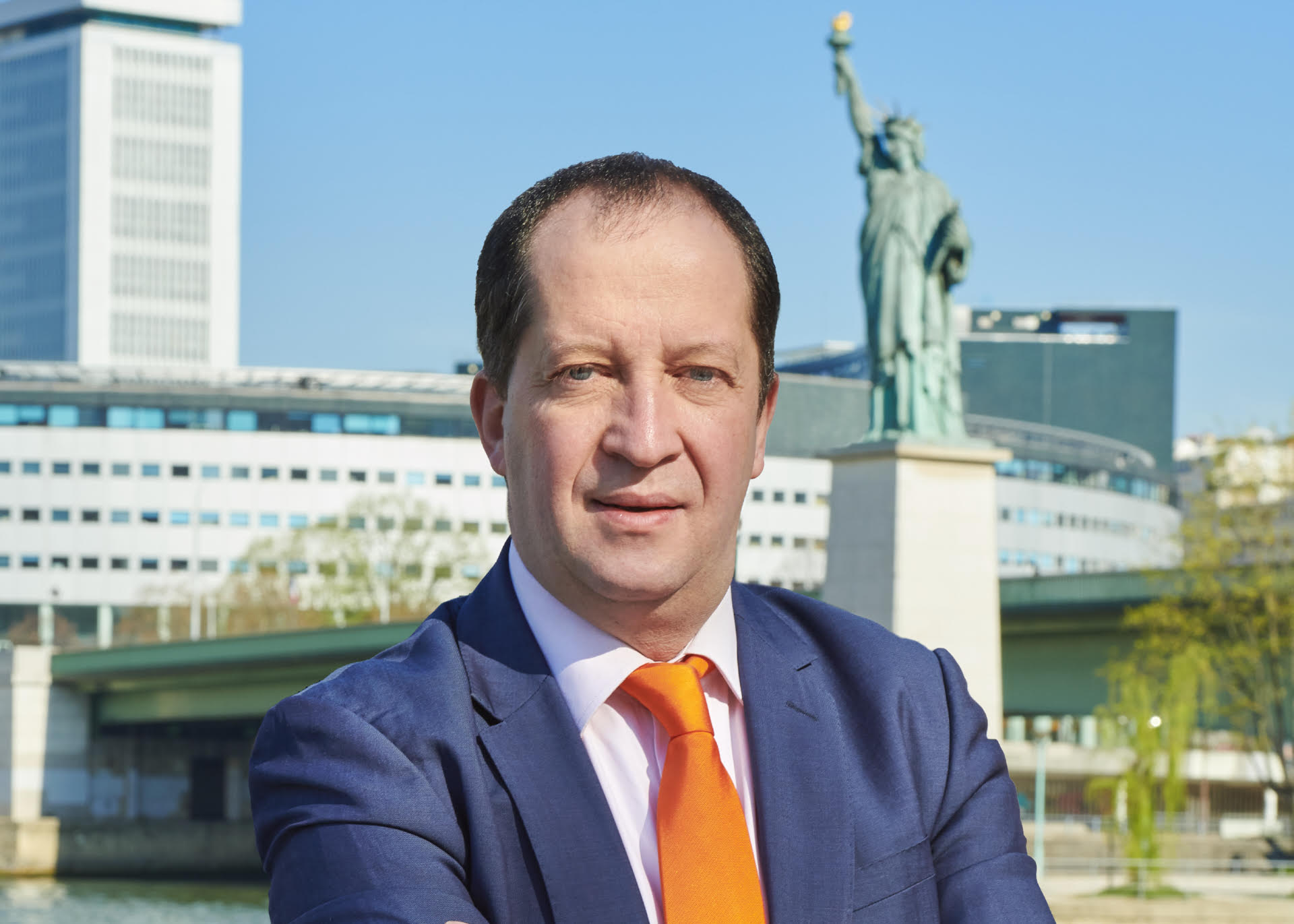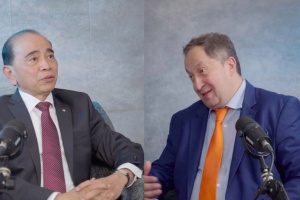




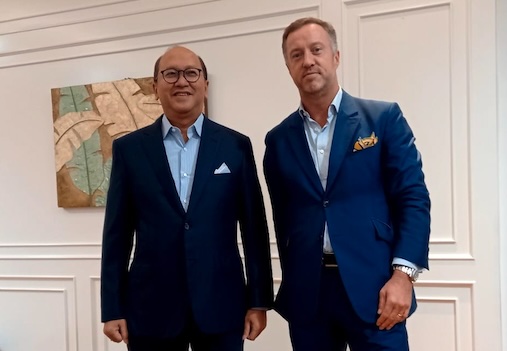
Rosan Roeslani, Indonesia’s Minister of Investment and Downstream Industries and CEO of Danantara Indonesia, with Pierre-Marie Relecom.
On the occasion of Indonesian President Prabowo Subianto’s state visit to France on May 28, Opinion Internationale met Pierre-Marie Relecom, president of Relecom & Partners, a specialist in mergers and acquisitions and project financing in high-growth countries, and vice president of the France-Indonesia Chamber of Commerce. A former high-level athlete in sailing and a businessman who has spent more than fifteen years between Europe and Asia, he offers a candid analysis of Indonesia’s potential, France’s delay, and the massive economic opportunities currently unfolding across the archipelago.
Opinion Internationale: Hello Pierre-Marie Relecom. Thank you for agreeing to speak with us for this special Indonesia edition published on the occasion of the Indonesian president’s state visit to France. What role does Indonesia play in your business activities?
Pierre-Marie Relecom: Today, India and Indonesia account for between 70 and 80 percent of our activity. This is no coincidence. These are countries concentrating a major share of current Asian and global growth. In addition to my professional activities, I represent the Franco-Indonesian Chamber of Commerce and Industry in France and serve as vice president of the Franco-Indian Chamber of Commerce in Paris.
You are passionate about sailing. Indonesia has more than 17,000 islands and France possesses the world’s second-largest maritime domain. Is the French maritime cluster sufficiently present in Indonesia today?
Indonesia has around 200 significant ports but only about twenty truly industrial ports. For the past fifteen years, the country has pursued an extremely ambitious maritime connectivity strategy aimed at efficiently linking its entire territory and integrating international trade routes. This involves massive investments in port infrastructure, shipping routes, logistics, and supply chains.
French groups such as CMA CGM, Louis Dreyfus Armateurs, and AGL are already present. Companies specialized in infrastructure and port financing are also working on several projects.
But generally speaking, French companies know Indonesia very poorly. For many French executives, the country still boils down to Bali, or perhaps Java for the more informed. They imagine a distant, underdeveloped, complicated country with little industry and major cultural or linguistic barriers. Some even believe that the absence of a direct Air France flight proves the market is not strategic. That is a major mistake.
So you believe French companies are missing out on a key market?
Absolutely. Yet the French were once very present in Indonesia. In the 1980s and 1990s, major French groups contributed to transforming the country. Jakarta airport’s Terminals 1 and 2 were built by SAE, later becoming Eiffage. Many of Jakarta’s skyscrapers were also built by French firms. Bouygues was active in dredging, Suez in water infrastructure.
Then came Suharto’s fall and the Asian financial crisis. Many French groups left abruptly and never truly returned. Apart from strategic players in maritime industries, Danone in food, and a small community of French expatriates determined to build bridges between the two countries, it is time for Indonesia to become a new conquest market for France.
What personally convinced you of Indonesia’s potential?
At first, I knew absolutely nothing about it. One of my clients asked whether I could support an acquisition in Southeast Asia. I confidently answered yes while actually discovering the region at the same time.
I was then fortunate enough to meet influential personalities who helped me understand Indonesia’s economic, relational, and decision-making codes. Since 2015, I have traveled to Indonesia between ten and fifteen times a year. I have a partner and friend there, Antoine de Carbonnel, who has lived in the country for eighteen years.
When you spend time there, you witness a country evolving extremely rapidly: the emergence of a huge middle class, accelerated industrialization, a more sophisticated private sector, infrastructure development, and investments in education and logistics.
Indonesia is an extraordinarily wealthy country. It possesses gas, coal, nickel, gold, bauxite, and many other strategic resources. It is a land blessed with natural wealth and human potential, a kind of Asian Democratic Republic of Congo, but with far more structured industries and economic organization.
How would you describe the country’s political and economic system today?
The private sector is extremely dynamic. Major industrial and economic families are often educated in the United States or Germany. Many Indonesian executives are brilliant and highly modern in their approach.
On the other hand, the administration remains heavier and sometimes paralyzed by fear of corruption accusations or charges of “damaging state finances.” Some public officials prefer signing nothing rather than risking legal trouble.
This slows down certain projects, even though the progress made over the past fifteen years has been considerable.
Indonesia remains an oligarchic democracy where major economic and political families continue to play an important role. But one should not caricature the country. The economic momentum is very real. And President Prabowo Subianto is clearly accelerating Indonesia’s rise.
Is Indonesia experiencing a significant protectionist shift?
Yes, and it is openly acknowledged. President Prabowo Subianto is pushing a “Make in Indonesia” policy. The idea is simple: whatever can be produced locally must be produced locally.
Implementation has sometimes been abrupt and counterproductive in the short term. Some companies suddenly faced import restrictions or local production requirements.
In the short term, this creates tensions. But in the medium and long term, it will likely accelerate industrialization.
And I insist: this protectionism is actually an opportunity for French companies, provided they are willing to establish themselves locally and invest alongside the right Indonesian partners.
For example, from October onward, all food and cosmetic products will have to comply with Indonesian halal standards. Producing directly in Indonesia will become essential for full market access.
Which sectors currently offer the greatest opportunities for French companies?
Defense is already benefiting from major contracts signed with France through Dassault, Naval Group, and Thales, and I am convinced this will continue.
But I would highlight two particularly promising sectors.
First, agri-tech represents a tremendous opportunity. The government wants to develop massive food programs and strengthen the country’s agricultural sovereignty. President Prabowo has committed to providing free meals to all children in schools. Yet the logistical, agricultural, and human challenge this represents requires expertise that French companies can provide.
And apart from Danone, there are still very few strongly established French actors.
Second, civil nuclear energy represents a huge strategic sector. Indonesia wants to accelerate its energy transition and strengthen its electrical autonomy. French companies were among the first approached thanks to France’s excellent image in this field. Yet for now, silence from many French players.
Healthcare, sustainable mobility, and clean energy could also be mentioned.
But there is urgency because Russians, Chinese, Koreans, Japanese, and Canadians are moving extremely quickly. I find it incomprehensible that some French groups still consider the market “too early.”
What advice would you give a French entrepreneur wishing to establish operations in Indonesia?
The first piece of advice is to be extremely well surrounded locally. You need partners capable of opening the right doors and neutralizing questionable practices. Most importantly, you must build strong personal relationships with the right economic families and decision-making centers. Even if legally possible, entering the market alone is a major strategic mistake.
Secondly, time is essential. Many French executives still believe they can make two trips, sign a contract, and leave. It does not work that way.
Finally, one must be willing to return frequently, sometimes one week per month over several months, in order to build strong human relationships. In Indonesia, business is not done only in air-conditioned offices. It is built in the evening, in restaurants, over cigars or drinks. Indonesians want to know who you are personally before doing business with you.
The day you face an administrative, regulatory, or political problem, who will defend you? Nobody except your trusted local partner. You need a solid and respectable local partner capable of supporting and protecting you. And such relationships are not built in a few meetings. They require trust and sometimes even friendship.
Returning to Air France: do you call on the airline to open a direct Paris-Jakarta route?
Of course. There are already direct flights to Vietnam and Thailand.
What message would you like to send to French companies during this presidential visit?
We can no longer ignore a country of nearly 290 million inhabitants growing at 5 to 6 percent annually, with immense natural resources and rapidly upgrading industries.
But we must also understand one essential reality: in Indonesia, financing remains the key issue. If you arrive with structured financing solutions for infrastructure, energy, environmental, or transport projects, you have already completed a large part of the journey.
The financing exists. The opportunities exist. Indonesians want to work with European and French companies. French businesses simply need to finally view Indonesia as a strategic priority rather than an exotic distant destination.
Moreover, President Prabowo and many Indonesian decision-makers are deeply Francophile. Emmanuel Macron has clearly understood this, and this state visit highlights the strong friendship between our two countries. The business world must now fully grasp it.
As a friend once told me, Indonesia is Asia’s last dragon, and it has finally awakened.
Interview conducted by Michel Taube
|
|
Issue Indonesia in Paris On the occasion of the state visit of President Prabowo Subianto to France on May 28, 2026, Opinion Internationale is publishing a special Indonesia edition. Interviews with French figures at the forefront of the economic rapprochement between French and Indonesian industries, analysis by geopolitical journalist Harold Hyman, and a portrait of one of Asia’s most Francophile leaders: this dossier is a call to French business leaders to invest in Southeast Asia’s largest market.
|
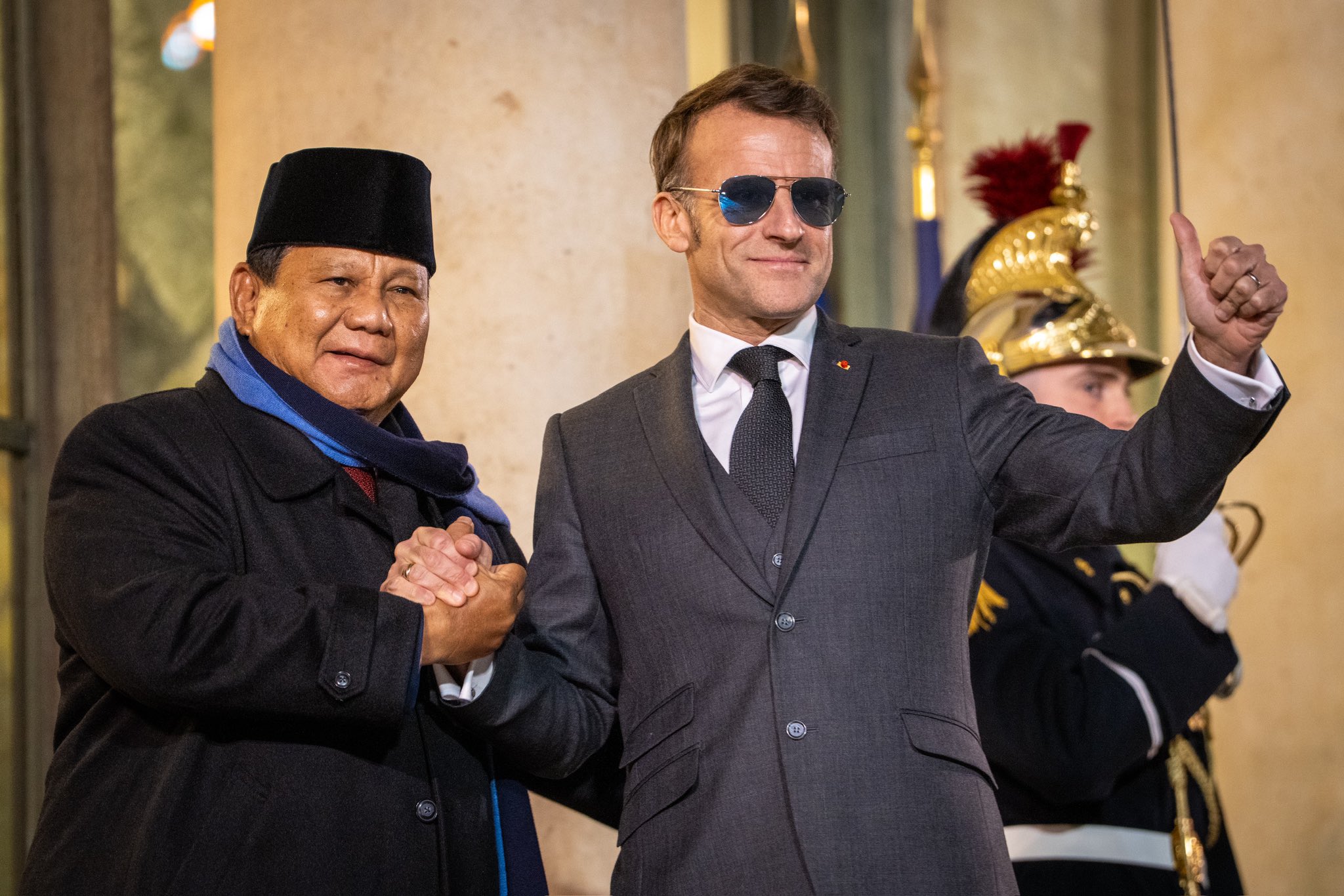
Contents:
Prabowo Subianto, France’s unexpected friend
Harold Hyman: the inevitable win-win relationship between Indonesia and France
This dossier inaugurates a new section on the front page of Opinion Internationale: Opinion Indonesia.
A dossier produced in partnership with Relecom & Partners, a strategic player in Franco-Indonesian relations.