



For many years, relations between India and the Gulf monarchies were largely reduced to an equation of oil and manpower. Indian workers helped build Dubai, while the Gulf fuelled India’s industrial rise.
That chapter now belongs to the past.
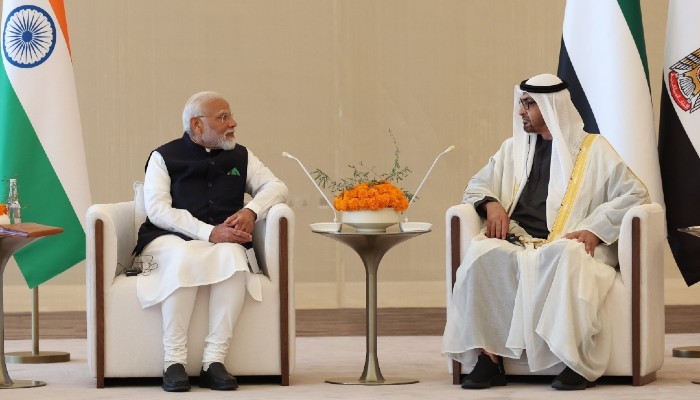
The rapprochement between Narendra Modi and the Gulf emirs reveals a far deeper transformation. It embodies the rise of a new Indo-Muslim axis — one that is energetic, strategic, technological and commercial, yet rooted above all in pragmatism.
Abu Dhabi is no longer merely investing in infrastructure.
The Emirati sovereign wealth fund has committed nearly 100 billion dollars, a substantial portion of it through direct investment in India’s GDP, within a broad partnership tied to global supply chains. By 2032, the two nations aim to reach 100 billion dollars in annual trade and exchanges.
The Emirates are now providing India with cutting-edge military technologies, while New Delhi seeks to make them one of the central pillars of its strategic autonomy.
This acceleration is far from anecdotal. It reflects a new reality: India is no longer simply a vast market. It is becoming a power with which the Gulf seeks to build.
Clearly, India now stands at the heart of a new geopolitical architecture. The Gulf powers no longer merely seek Indian labour and stability; they now wish to shape a strategic future alongside it.
And why? Because the Gulf, fully aware that the age of oil will not last forever, is searching for a reliable partner capable of guaranteeing food security, advancing technological transformation, and even enabling the storage of up to 30 million barrels of oil on Indian soil.
From a European perspective, this shift still goes largely unnoticed. Yet it may well prove to be one of the defining geopolitical transformations of the coming decade — one that will profoundly reshape balances of power, maritime security routes and even global energy governance.
The Gulf increasingly turns toward India
For decades, the Gulf monarchies looked primarily toward Washington, London or Beijing. Today, they increasingly understand that a large part of the future is being forged in Asia.
Narendra Modi grasped this opportunity early on. Since 2015, he has multiplied state visits across the region and cultivated a close personal relationship with Emirati President Mohammed bin Zayed Al Nahyan.
Artificial intelligence, port infrastructure and infrastructure projects, space, cybersecurity, and increasingly intensive supercomputers — everything is now part of it. But India’s muscular diplomacy is also becoming military. New Delhi and Abu Dhabi have signed an ambitious strategic defence partnership framework.
In this context, India seeks above all to secure its trade routes and protect its interests without becoming entangled in the direct confrontations of the great powers. A subtle diplomatic balancing act… yet one that will become increasingly difficult to maintain, on the one hand because India remains heavily dependent on energy imports from the Gulf, and on the other because the Emirates continue to be closely tied to the regional balances surrounding the Moyan-Orion tensions.
Beyond the major contracts and strategic announcements, another question often remains unspoken: the millions of Indian workers living in the Gulf. They constitute the true human backbone of this relationship. Their financial transfers to India amount to billions of dollars each year. Yet their social conditions, rights and vulnerabilities sometimes remain sensitive issues.
Modi’s India is therefore pursuing a delicate equation: defending its strategic interests without appearing dependent; developing its partnerships without renouncing its diplomatic autonomy.
Narendra Modi’s visit to the Emirates ultimately sketches the contours of a new geography of the world, a new geopolitical map upon which the India-Gulf axis could become one of the most powerful forces of the twenty-first century.
Michel Taube