



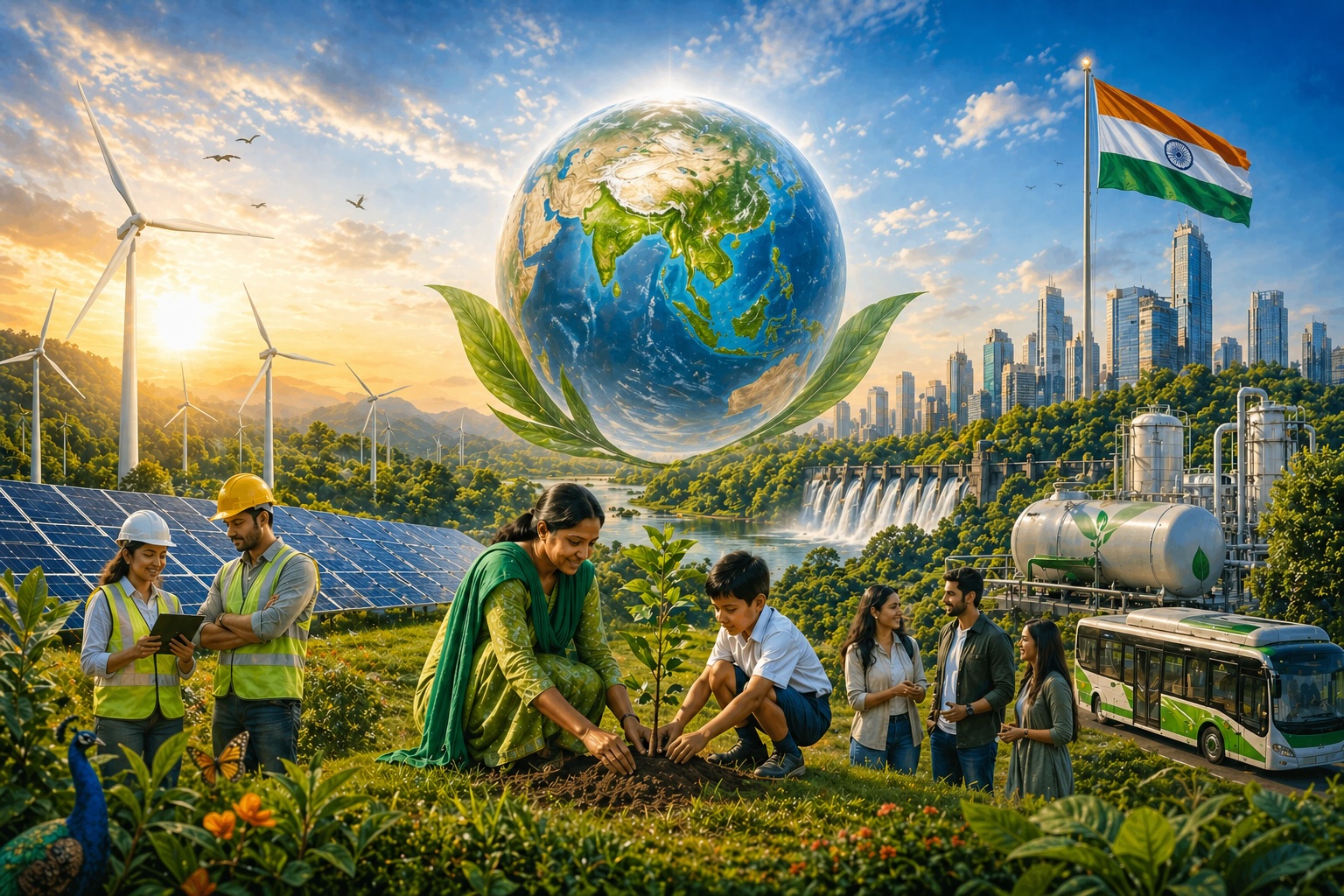
India has emerged as a responsible and proactive global actor in the fight against climate change, demonstrating that economic development and environmental protection can go hand in hand. Despite being a developing country with significant energy and growth requirements, India has made notable strides in advancing sustainability, expanding clean energy, and contributing constructively to global climate efforts.
A cornerstone of India’s environmental strategy has been its rapid transition towards renewable energy. As of March 31, 2026, India has installed approximately 283.5 GW of non-fossil fuel capacity, including around 275 GW of renewable energy (with solar at 150.3 GW, wind at 56 GW, and large hydro contributing significantly). This milestone enabled the country to achieve 50% of its cumulative installed electricity capacity from non-fossil fuel sources in June 2025, five years ahead of its 2030 target under the Nationally Determined Contribution (NDC) to the Paris Agreement. India added a record 55.3 GW of non-fossil power capacity in FY 2025-26 alone, the highest in any single year. The country now ranks third globally in renewable energy installed capacity.
Ambitious goals, including scaling up to 500 GW of non-fossil fuel capacity by 2030 and achieving net-zero emissions by 2070, further underline India’s long-term vision. In 2025-26, non-fossil fuels accounted for 29.2% of total electricity generation (538.97 billion units).
India’s progress is also evident in its emissions trajectory. The country successfully reduced the emissions intensity of its GDP by 36% between 2005 and 2020. It has since updated its targets, committing to a 47% reduction by 2035. This reflects a gradual decoupling of economic growth from carbon emissions, supported by strong policy interventions such as incentives for clean energy manufacturing, regulatory reforms, and the promotion of green hydrogen.
A flagship effort in this direction is the National Green Hydrogen Mission (launched in 2023), which aims to produce 5 million metric tonnes (MMT) of green hydrogen annually by 2030. As of early 2026, India has commissioned around 8,000 tonnes per annum of green hydrogen production capacity, with early tenders discovering competitive prices for green ammonia supply to fertiliser plants.
Equally important has been India’s emphasis on natural climate solutions. Large-scale afforestation and forest conservation programmes have enhanced carbon sinks while supporting biodiversity and rural livelihoods. According to the FAO’s Global Forest Resources Assessment (GFRA) 2025, India has climbed to 9th position globally in total forest area (72.7 million hectares, about 2% of the world’s forests) and maintains 3rd rank in net annual forest area gain, adding approximately 191,000 hectares per year between 2015 and 2025. Initiatives such as the Green India Mission, the Compensatory Afforestation Fund Management and Planning Authority (CAMPA), and the public campaign “Ek Ped Ma Ke Naam” (One Tree in the Name of Mother) have driven community participation in tree planting.
At the global level, India has played a leadership role in shaping climate discourse and promoting collective action. The International Solar Alliance (ISA), co-founded by India and France in 2015, now brings together over 100 countries to promote solar energy deployment. Complementing this is the visionary “One Sun, One World, One Grid” (OSOWOG) initiative, which aims to create an interconnected global green energy grid for sharing solar and renewable power across time zones, with India positioned as a central hub. Other notable efforts include the Lifestyle for Environment (LiFE) movement, which encourages sustainable consumption patterns.
A key aspect of India’s climate position lies in its minimal historical contribution to global emissions. India accounts for only around 3–4% of cumulative historical CO₂ emissions since the industrial era, despite representing nearly one-sixth of the world’s population. Its per capita emissions remain significantly below the global average. This context informs India’s consistent advocacy for equity and the principle of common but differentiated responsibilities (CBDR) in international climate negotiations.
Taken together, these efforts demonstrate that India has advanced environmental protection while addressing its developmental imperatives. Its achievements in renewable energy expansion (reaching 50% non-fossil capacity ahead of schedule), emissions intensity reduction, forest conservation (9th globally in area, 3rd in annual gain), promotion of green hydrogen, and global climate leadership through ISA and OSOWOG underscore a balanced, equitable, and forward-looking approach.
As the world confronts the urgent challenge of climate change, India’s model, grounded in sustainability, equity, innovation, and inclusive growth, offers valuable lessons for achieving effective and just climate action.
Michel Taube