



India’s stance toward the ongoing conflicts in the Middle East—particularly the recent escalation involving Iran—reveals a finely balanced diplomacy. It lies at the intersection of strategic autonomy, historical commitments, and contemporary geopolitical realities. A close reading of statements issued by the Ministry of External Affairs shows that New Delhi is pursuing a line that is at once principled and pragmatic, carefully calibrated.
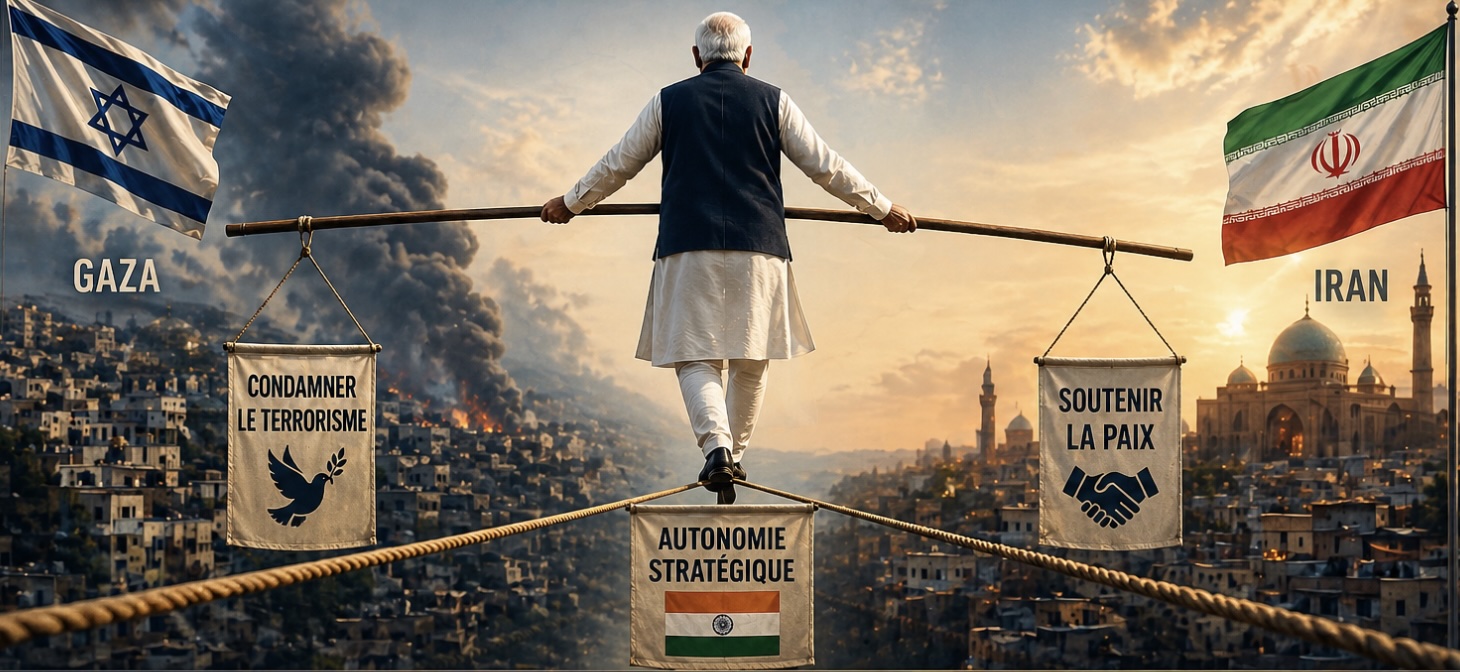
Since the outbreak of war between Israel and Hamas in October 2023, followed by the spread of tensions across the region in 2025 and into the present, India has maintained a remarkably consistent diplomatic posture. From the outset, New Delhi firmly condemned the Hamas attacks, expressing explicit solidarity with Israel. At the same time, Indian authorities emphasized the need to protect civilians and to avoid any uncontrolled escalation—signaling a refusal to endorse an open-ended military response. Thus, despite the strengthening of its strategic partnership with Israel, India has never disavowed its longstanding support for the Palestinian cause. In various international forums, notably the United Nations General Assembly, it has reaffirmed its commitment to the emergence of a sovereign and independent Palestinian state living in peace alongside Israel.
Iran: A Test Case for Strategic Autonomy
The escalation involving Iran in 2026 has further complicated the regional equation. Here again, India has favored a path of de-escalation and dialogue, without explicitly aligning itself with any military bloc.
This posture is far from improvised. India maintains significant relations with Iran, particularly through the strategic port of Chabahar Port, while simultaneously deepening its ties with Israel and the United States. Taking sides would risk unsettling this delicate balance.
Statements by Narendra Modi reflect this approach. After expressing clear solidarity with Israel, the Prime Minister also underscored the importance of peace, humanitarian assistance, and regional stability. This nuanced shift mirrors India’s broader posture: firm in its stance against terrorism, yet cautious in the face of escalating dynamics.
India’s strategy rests on several structuring determinants:
- Energy security: the Middle East remains a major source of oil supply.
- The diaspora factor: millions of Indian nationals live and work in the Gulf countries, while India also hosts a significant Iranian diaspora.
- Strategic partnerships: Israel is a key partner in defense and innovation.
- Geopolitical flexibility: India cultivates diversified relationships, including with Iran and Arab states, within a logic of “multi-alignment.”
A Balancing Power in a Fragmented World
Far from hesitant or ambiguous, India’s position appears as a deliberate choice of equilibrium. Through consistent diplomatic communication, New Delhi seeks to uphold international norms while safeguarding its national interests.
In this region as elsewhere, a broader ambition can be discerned: to assert itself as an autonomous power, capable of acting as a stabilizing voice in an increasingly polarized international order.
Michel Taube