



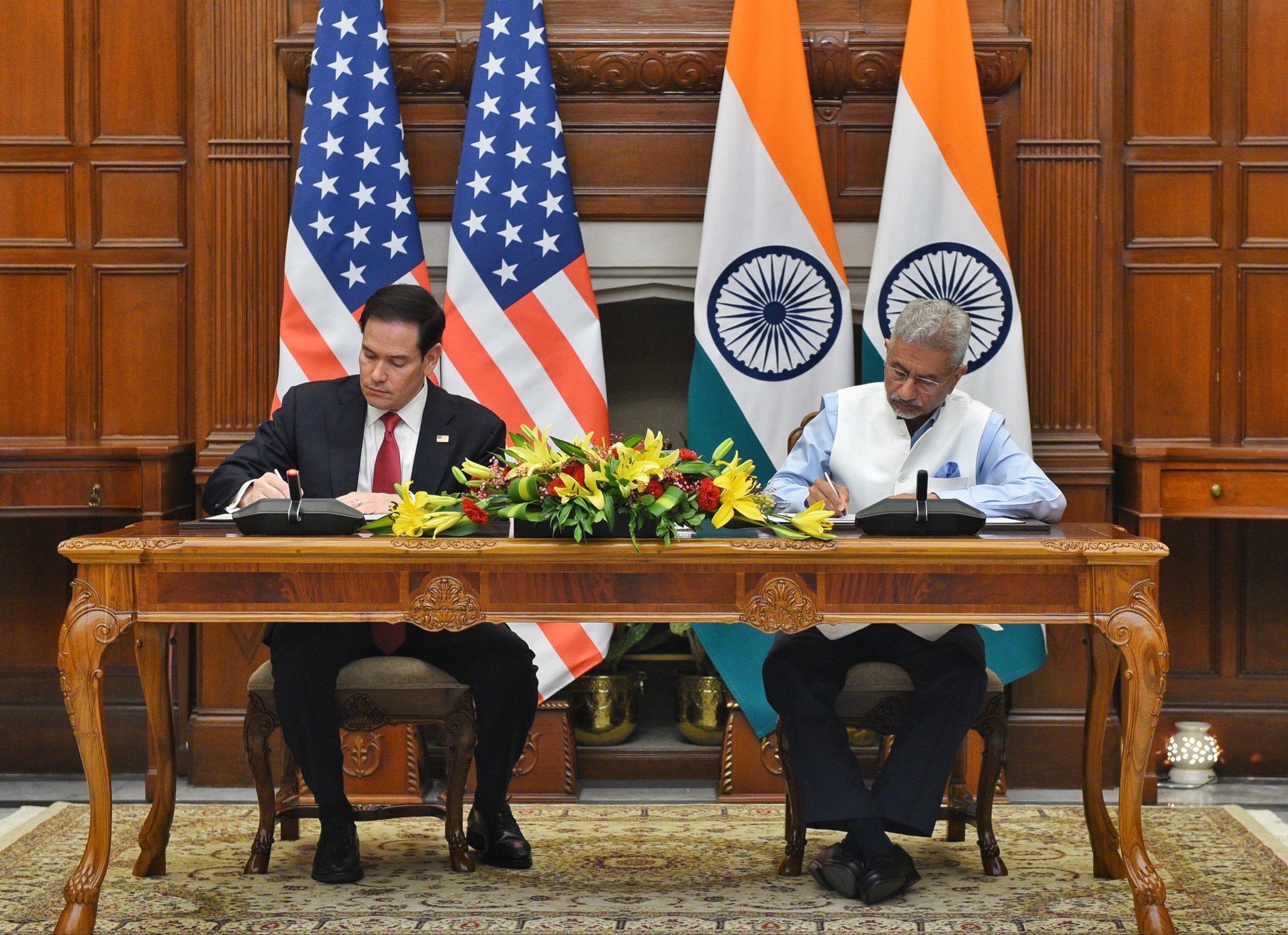
Le secrétaire d’État américain Marco Rubio (g) et le ministre indien des Affaires étrangères Subrahmanyam Jaishankar ont signé un protocole d’accord à New Delhi, le 26 mai 2026
Are you familiar with the Quad? Not the all-terrain vehicle, but the Quadrilateral Security Dialogue, an informal framework for military and diplomatic cooperation bringing together the United States, India, Japan and Australia.
U.S. Secretary of State Marco Rubio’s visit to India on May 23 to attend the Quad Foreign Ministers’ Meeting was anything but a routine diplomatic trip. Against a backdrop of trade tensions, geopolitical realignments and strategic uncertainty across the Indo-Pacific, the visit looked more like an exercise in strategic clarification between two democracies that have become indispensable to one another—yet not always aligned.
For Marco Rubio, it was his first official visit to India since assuming the helm of American diplomacy.
And behind the carefully choreographed images and diplomatic protocol, one question overshadowed all others: are the United States and India still capable of building a stable strategic relationship in a world that has become profoundly transactional?
The diplomatic centerpiece of the visit was, of course, the Quad itself—the strategic partnership uniting India, the United States, Japan and Australia. Established to strengthen cooperation throughout the Indo-Pacific, the Quad has gradually emerged as a key platform for coordination on maritime security, supply chains, critical technologies, strategic minerals, cybersecurity and regional stability in the face of China’s growing assertiveness.
Yet in recent months, some observers have begun to question the grouping’s real momentum. The absence of a leaders’ summit in 2025 has fueled doubts about the alliance’s political cohesion.
Marco Rubio therefore sought to reassure his counterparts. He described the Quad as a “pillar” and a “cornerstone” of America’s Indo-Pacific strategy.
The message was unmistakable: despite the turbulence of domestic politics, Washington has no intention of ceding the Asian theatre to Beijing.
Yet behind the official declarations, relations between Washington and New Delhi are going through a more delicate phase than at any point in the past decade.
Trade tensions triggered by U.S. tariffs, disagreements over India’s purchases of Russian oil, and Washington’s recent rapprochement with Islamabad have all contributed to a growing sense of mistrust on the Indian side.
The U.S. administration is now seeking to stabilize the relationship without abandoning its own economic priorities. India, for its part, is proceeding with caution.
For New Delhi now rejects any logic of automatic alignment. Indian diplomacy favors what it calls “strategic autonomy”: cooperating with the United States without becoming dependent upon Washington. It is the defining principle of Narendra Modi’s foreign policy.
Discussions between Marco Rubio, Prime Minister Narendra Modi and India’s External Affairs Minister Subrahmanyam Jaishankar focused on several key strategic issues: energy, defense, emerging technologies, maritime security, artificial intelligence and supply-chain resilience.
The United States is particularly eager to expand its energy exports to India in order to reduce New Delhi’s dependence on Russian hydrocarbons.
India, meanwhile, is primarily seeking to diversify its partnerships without allowing itself to become trapped in the Sino-American rivalry.
In other words: cooperate with Washington without breaking with Moscow; engage with the West without turning its back on the Global South.
This delicate balancing act has become the hallmark of Indian diplomacy.
The Quad remains important. The Indo-American partnership does too. But New Delhi has no desire to become merely the Asian link in an American strategy of containment against China.
And Washington is gradually coming to understand that its relationship with India can only function as a partnership between equals—not as one between protector and protected.
For Marco Rubio’s visit to New Delhi ultimately revealed just how profoundly the world is changing.
For decades, alliances were relatively straightforward: one bloc against another. Today, however, the major middle powers—India, Turkey, Saudi Arabia and Brazil—refuse to choose between Washington and Beijing. They seek to negotiate with all sides, defend their own interests and assert their strategic sovereignty.
India probably embodies this new reality better than any other nation. And it fully intends to become one of the leading champions of this new form of 21st-century non-alignment.
Michel Taube