



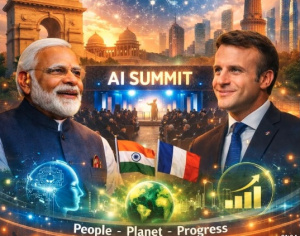
There are moments that do not merely belong to the diplomatic calendar, but rather mark the awakening of a new chapter in history. The AI Impact Summit, to be held from 16 to 20 February in New Delhi, in the presence of Emmanuel Macron and Narendra Modi, belongs to this rare category. It is not just another conference in the already saturated agenda of world powers; it is a turning point, a deliberate attempt to redraw the mental map of the technological, strategic, and civilizational world.
AI Impact Summit in India
Last year in Paris, France and India laid the foundations for an ambitious partnership. This year, New Delhi is taking up the mantle and broadening the horizon. More than one hundred and thirty countries, dozens of heads of state and government, dozens of ministers, leaders of the world’s largest technology companies, more than five hundred expert sessions, and a profusion of startups presenting their solutions — the scale is dizzying. But behind the numbers lies a vision.
India no longer wants to be merely the world’s digital workshop. It seeks to become the strategic conscience of the “Global South,” the architect of a third path between American hyperpower and the Chinese hegemonic temptation.
With its “India AI Impact Summit 2026,” India is shifting the center of gravity of the debate: for the first time, users, populations, and developing states are placed at the heart of the reflection, rather than solely the producers of algorithms. This represents a major symbolic and political reversal.
The “Sutras” proposed by New Delhi are not simple slogans.
People: AI serving humanity, fundamental rights, and dignity.
Planet: Technology designed for sustainability, environmental resilience, and responsibility.
Progress: Inclusive growth and innovation that does not abandon either regions or the middle classes.
There is, in this vision, an ambition that is almost Gaullist in its refusal of fatalism, and almost Gandhian in its moral rigor.
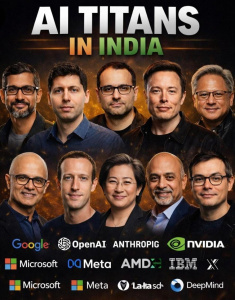
France, a privileged partner
This summit is more than a gathering of decision-makers. It is a laboratory for global governance.
The announced presence of major political leaders such as Luiz Inácio Lula da Silva and David Lammy, alongside tech titans such as Sundar Pichai, Sam Altman, Jensen Huang, Demis Hassabis, Alexandr Wang, and Bill Gates, reflects an undeniable reality: artificial intelligence is no longer just a sector — it has become the very backbone of the 21st century.
Whoever controls AI controls economic, military, and cultural power.
France, for its part, is sending its head of state. That Emmanuel Macron — whose Indo-Pacific vision deserves recognition — is traveling from 17 to 19 February to strengthen the France–India partnership is not a mere protocol detail. France, a balancing power, a scientific nation, and the homeland of the Enlightenment, finds in India a partner that shares the conviction that there can be no sovereignty without technological mastery.
In this context, Coumar Ananda, President of the Franco-Indian Chamber of Commerce and Industry, welcomes the fact that, “building on a strong strategic partnership covering defense, space, nuclear energy, and maritime security, France and India are now strengthening their cooperation in AI and technological sovereignty.”
Together, Paris and New Delhi seek to promote a demanding vision: AI that is regulated yet bold, ethical yet competitive, open yet sovereign.
In this meeting between Macron and Modi, there is a shared promise: that of a democratic axis capable of speaking to the entire world, reconciling innovation with responsibility, competitiveness with humanism. At a time when some dream of a world governed by algorithms and others fear a technological dystopia, New Delhi and Paris fundamentally seek to ensure that human intelligence remains in command of artificial intelligence.
India at the center of the circle
The New Delhi Summit raises a simple yet dizzying question: will AI become the instrument of a new divide between dominant and dominated nations, or the tool for a global rebalancing?
India answers by proposing a “third way” between the United States and China, between North and South, between East and West, between the West and the rest of the world: neither alignment nor confrontation, but the assertion of a multipolar world based on dialogue rather than constant rivalry between powers.
Through strategic autonomy, inclusive innovation, and ethical leadership, India is positioning itself as a bridge between worlds, demonstrating that technological power can coexist with fairness, and that the next era of AI can be shaped by partnership, dignity, and collective progress.
For the French and the Indians, the stakes are also democratic. According to Guillaume Bigot, RN member of parliament and member of the France–India friendship group in the National Assembly, “American and Chinese tech giants are shaping a world in which algorithms will mercilessly crush our freedoms.” The RN’s geopolitics spokesman adds: “India, the world’s largest democracy, and France, the country of human rights, therefore have every interest in joining forces to reinvent democracy in the age of AI.”
Yes, this summit is a moment of legitimate pride for India. But above all, it is a signal: the 21st century will not be decided solely in Silicon Valley laboratories or in Asian research centers; it will also be shaped by the ability of nations to cooperate, to engage in dialogue, and to think about the future together.
And if, in a few years, we were to look for the starting point of a new global governance of AI, we may well remember this week in February in New Delhi, when major democracies decided to make technological power rhyme with political responsibility.
Michel Taube