



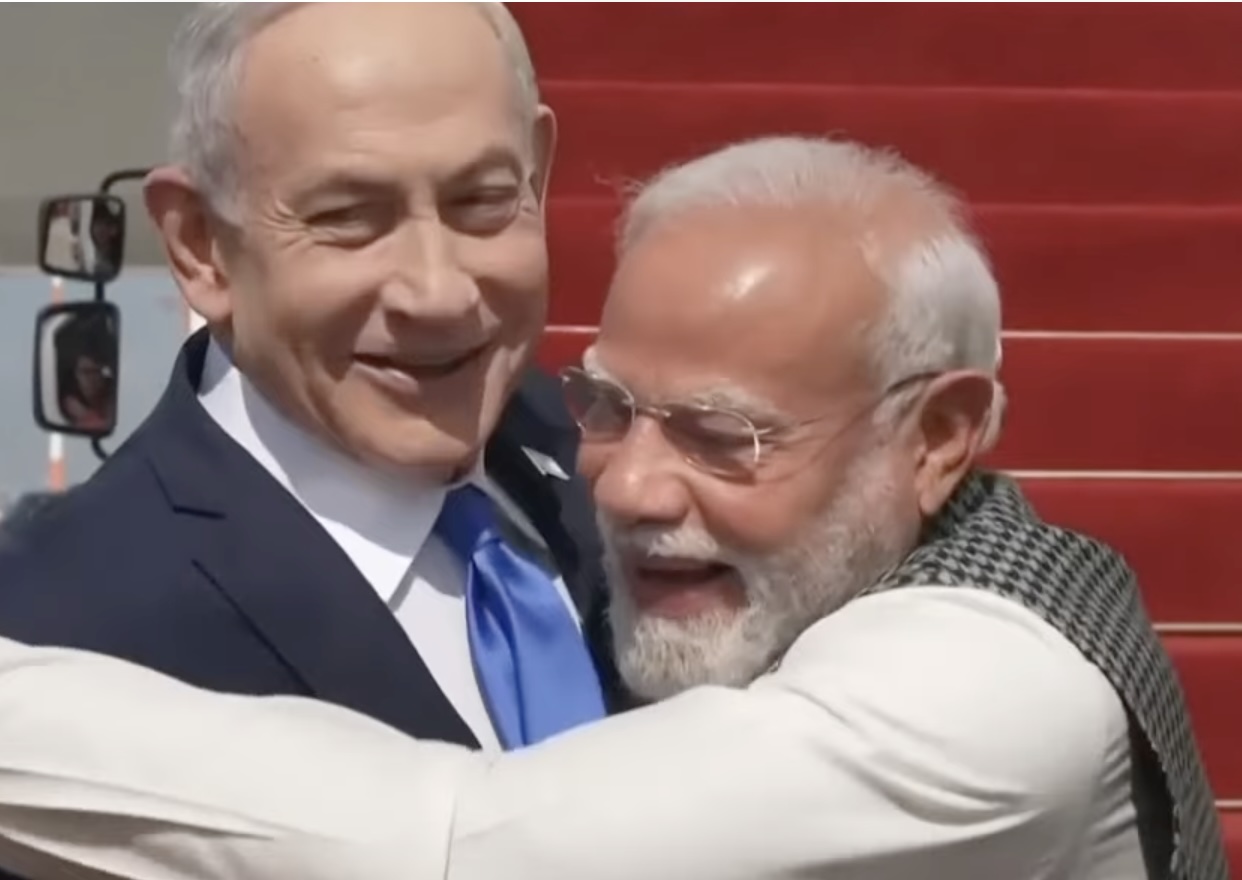
The state visit of Indian Prime Minister Narendra Modi to Israel unquestionably belongs to that rare category. By setting foot on Israeli soil to meet Benjamin Netanyahu and by addressing the Knesset, the leader of the world’s largest democracy did not merely carry out a protocol visit to the region’s only democratic country. He performed a major, almost foundational geostrategic act in the silent yet accelerating reshaping of international balances.
The symbol is powerful. By concluding his speech with a vibrant “Am Yisrael Chai,” Narendra Modi sent a clear message, readable from Jerusalem to New Delhi, but also from Tehran to Washington and from Beijing to Brussels. Yes, India now fully embraces its closeness to Israel. Yes, two great ancient nations, two democracies confronted with terrorism and regional turmoil, now intend to move forward together. And yes, this unprecedented axis deserves to be regarded with attention, if not with respect, in an increasingly fragmented world.
For beyond the words, the convergences run deep. India and Israel share the same lucidity in the face of the terrorist threat, whether it strikes in Mumbai or bloodies Israel on October 7. Both countries have long understood that strategic naivety always comes at a very high price.
Both also invest massively in disruptive technologies, artificial intelligence, cybersecurity, and digital innovation, convinced that tomorrow’s power will first and foremost be technological. Both, finally, seek to play a balancing role between the major blocs, refusing to be confined within the logic of automatic alignment.
One must grasp what this rapprochement represents. India is not a partner like any other. It is a demographic giant, a rapidly rising economic power, a diplomatic actor courted by all. By strengthening its ties with Jerusalem, New Delhi is sending a signal of strategic maturity, but also of asserted independence. And Israel, often isolated on the international stage, finds here a heavyweight ally — solid, credible, and enduring.
Of course, Narendra Modi does not ignore regional balances. India continues to engage in dialogue with the Gulf countries and even with Iran. But that is precisely what makes this visit even more significant. India, champion of a third way between the American and Chinese giants, joined by Israel, which is increasingly asserting its autonomy from the United States, shows that in the 21st century, the diplomacy of sovereign nations is no longer reduced to fixed camps. It is built through circles of interest, through concrete convergences, through pragmatic alliances.
In this troubled world, where fault lines are multiplying and yesterday’s certainties are eroding, the axis between India and Israel appears as a factor of stability that it would be imprudent to neglect. Two resilient democracies, two ancient civilizations, two technological powers choosing to draw closer in the face of common challenges: the signal is clear. And it may well rank among the most structuring geopolitical developments of the years to come.
Michel Taube