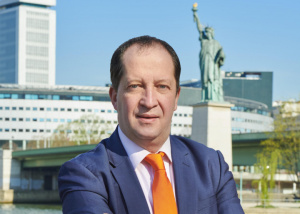




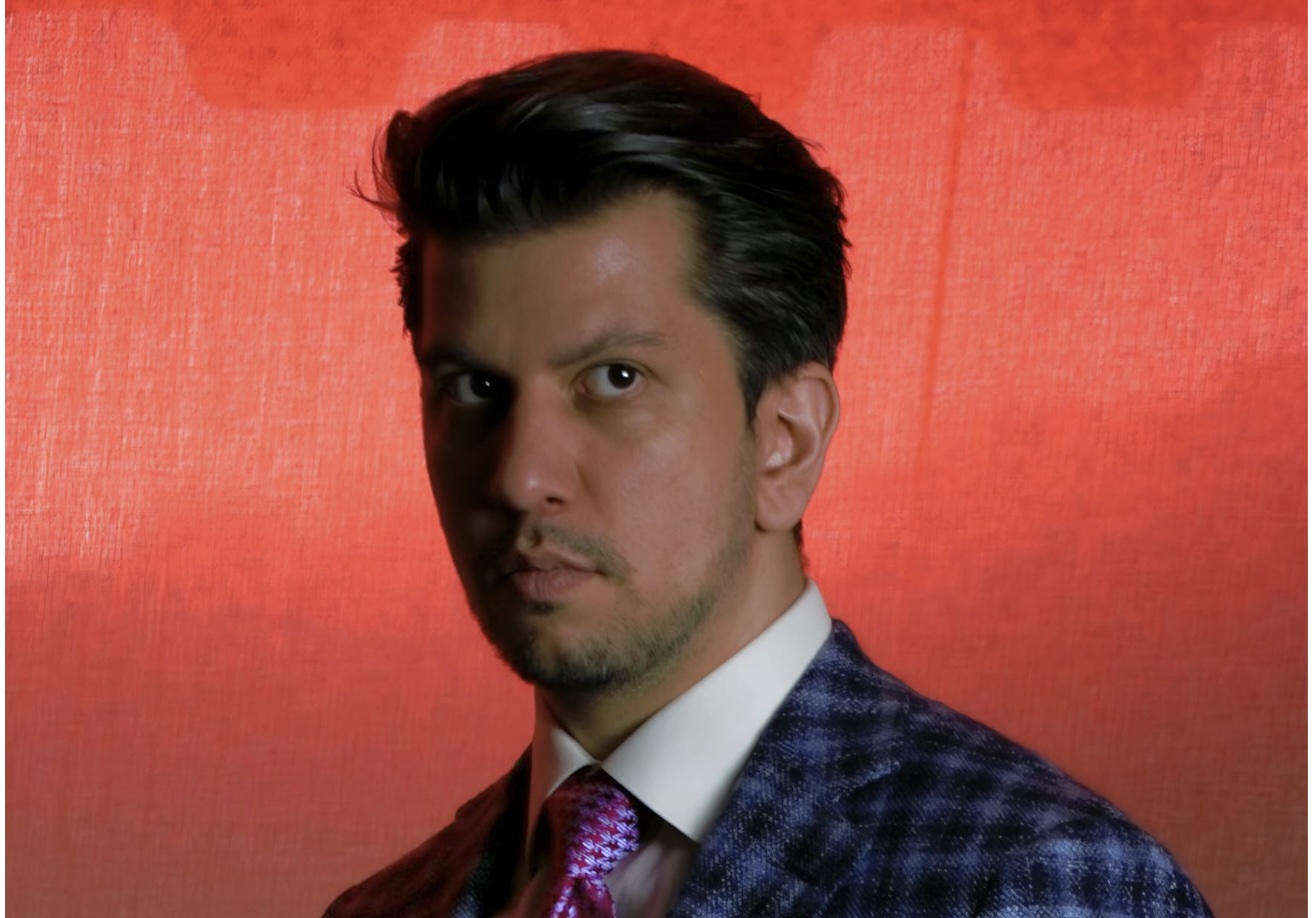
Ram Divedi is fully Franco-Indian: having grown up in France and spent most of his adult life in India, he is a business leader in a deep-tech company specializing in fundamental research, particularly in energy and mobility, with concrete industrial applications (military vehicles, drones, batteries, civilian vehicles, and engineering for major automotive and defense players).
Ram Divedi is also a geopolitics expert (he hosts the YouTube channel Bhaiya) and an active contributor to Franco-Indian relations. A professor of geopolitics, he heads a research laboratory dedicated to these issues and organizes delegations between France and India, guided by a logic of mutual interest between the two countries. He is known for having organized a lunch between Emmanuel Macron and Mukesh Ambani, Asia’s richest man, attended by Elon Musk and Bernard Arnault.
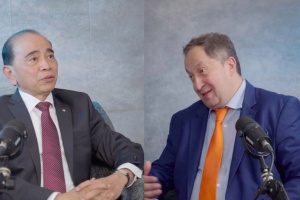
Ram Divedi speaks to Opinion Internationale about the key elements surrounding the AI Summit in New Delhi.
 Ram Divedi, thank you for speaking with Opinion Internationale on the occasion of the launch of our Opinion India section. What is your perspective on the AI Impact Summit currently taking place in New Delhi?
What must be understood is that, unlike France, India is not accustomed to regularly hosting major international events. And yet, the country has risen tremendously in recent years, climbing the rankings almost every year to become the world’s fourth-largest economic power, and soon the third. It has therefore become one of the driving engines of global growth.
However, there remains a gap between its real economic weight and the international perception of its power. This AI Summit is thus a way for India to demonstrate its capacity to bring stakeholders together around an issue that is strategic for the future of humanity.
The purpose of the summit is not merely to parade high-profile figures delivering speeches. Above all, it is about working groups and concrete discussions, “chakras,” as they are called in India, almost in the spirit of a COP, even though no formal international regulation will emerge at its conclusion. Topics on the agenda include the relationship between AI and work, the place of human beings in an AI-driven world, regulation, and broader societal impacts.
 Could this summit lead to concrete alliances, as was the case with the International Solar Alliance (ISA) initiated by France and India at COP21, rather than merely symbolic declarations?
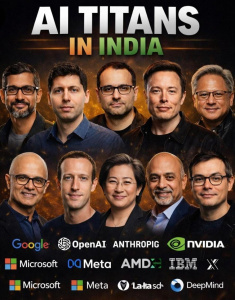
That is indeed the objective. Rather than staging a large-scale international gathering for appearances’ sake, the idea is to foster cooperation between economic, industrial, and political stakeholders. The strength of this edition lies in its ability to attract a broad range of global actors, even if some notable names are absent. At this level, personal relationships and rivalries among leading tech figures also play a significant role. Elon Musk may be somewhat distancing himself from certain competitors, but not India.
Between us, what is it about India’s Prime Minister, Mr. Narendra Modi, whom you know well, if my sources are correct, that explains his international stature and his determination to make India one of the El Dorados of AI?
IT does not occupy the same place in India as it does in France.
During the major economic reforms of 1991, India’s entire strategy was to bet heavily on information technology and pharmaceuticals. This gave rise to giants such as Tata Consultancy Services (TCS), Wipro, and Infosys.
In India, IT is not simply a “cool” industry, it has lifted hundreds of millions of people out of poverty.
Mr. Modi’s genius has been to understand that previous governments successfully transformed India from a call-center economy into a developer economy, and then into an R&D-driven one. Narendra Modi must now prove that he can deliver the next transition: artificial intelligence. To achieve this, he will do everything possible to attract capital and to demonstrate that India offers an alternative model to both the United States and China.
It is also important to recognize that many of India’s structural challenges have been addressed under Modi through digitalization, payments systems, access to public services, national identification and census mechanisms. However, in other areas, his major reform plans have not fully delivered. He is hoping that AI will help resolve those remaining challenges.
Is there an Indian, European, or specifically French approach to AI in the face of American and Chinese dominance? Ultimately, is India positioning itself as a kind of “third way,” as we suggested in the editorial devoted to this Summit?
Yes, clearly. India sees itself as a neutral, non-hegemonic actor, neither Western nor Chinese. I have sometimes used the image of a “mega Switzerland.” The idea is to offer a space for dialogue where everyone can feel at ease. This positioning makes it possible to bring together stakeholders who, elsewhere, would find it far more difficult to sit at the same table.
Artificial intelligence marks a historic turning point comparable to the great industrial revolutions. How societies choose to regulate and frame it will be decisive. The issue is not merely technological; it is profoundly political and human. India intends to make its contribution to that debate.
That said, we must not be naïve: those who master the technology and command the capital are the ones who dominate today. The United States and China remain ahead, while the rest of the world is still searching for its place. However, investment has been flowing abundantly into India in recent years, and we fully intend, together with our partners in the Global South and in Europe, to play a central role.
What constitutes India’s excellence in AI?
India is attracting massive investment into AI-related data centers and research hubs, with commitments of $17.5 billion from Microsoft, $15 billion from Google, and $35 billion from Amazon. The country is developing a modular approach to data center design, benefits from relatively competitive energy costs, and demonstrates strong political will to support the sector.
There is also a major talent dimension. India is seeking to bring back engineers who left for Silicon Valley and other global tech hubs, while encouraging younger generations to build their careers at home. Many leading figures in global tech are of Indian origin, and the country aims to transform this diaspora into a strategic advantage.
Let us take advantage of this interview to call on Elon Musk to rise above his rivalries with competitors, board one of his rockets, and make a last-minute landing in New Delhi as a surprise guest!
A good idea, but I have already poached a few talents from Tesla, so Elon Musk may hold it against me for life. But that is precisely what reverse brain drain is all about.
Will you be attending the Summit yourself?
Yes, I will be there. It is also a week marked by other events around design and luxury, with a strong French presence as well.
Interview conducted by Michel Taube