



India was born free on August 15, 1947. But it became fully sovereign, democratic, and republican on January 26, 1950, with the adoption of its Constitution. On that day, under a 21-gun salute, Dr. Rajendra Prasad took the oath as the first President of the Republic of India. The people officially took their destiny into their own hands.
Since then, each Republic Day has served as a reminder that democracy is never a given; it is built over time—through institutions, through law, through collective responsibility.
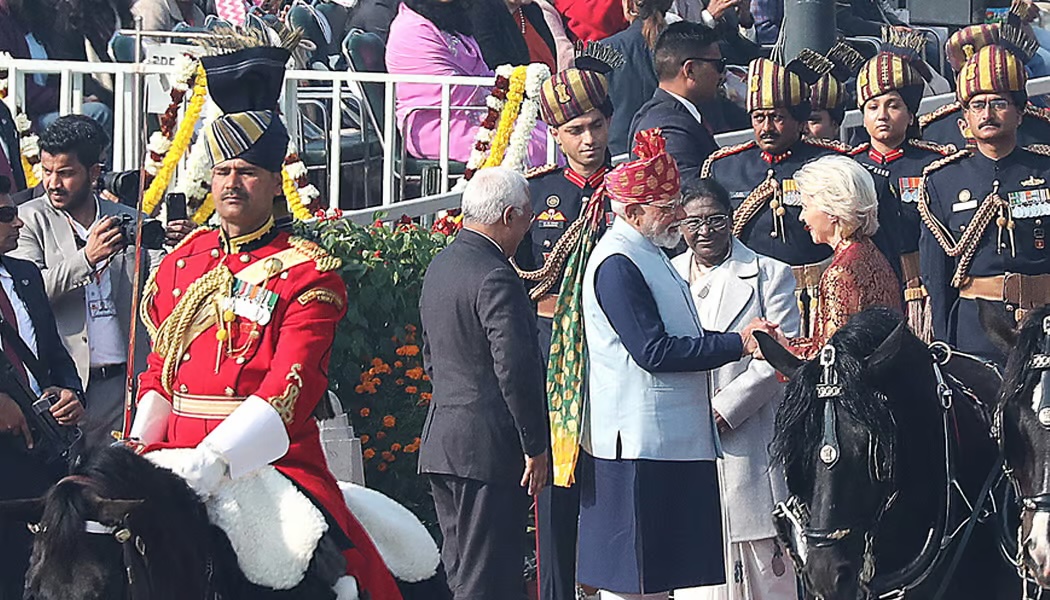
On January 26, 2026, along the majestic Kartavya Path, this founding memory once again came to life in a grand parade blending military strength, cultural diversity, and technological ambition. Before the eyes of the world, President Droupadi Murmu raised the national flag to the sound of the anthem, reminding all that modern India remains faithful to its roots.
Europe Invited to the Republican Celebration
The exceptional presence of Ursula von der Leyen and Antonio Costa, Presidents of the European Commission and the European Council respectively, as guests of honor, was not a mere protocol gesture. It was a message.
A message of strategic rapprochement between two major democratic poles of the 21st century.
The image of the President of the European Commission, dressed in a golden kurta, advancing in a carriage alongside the President of India, will remain a discreet yet powerful symbol: that of mutual respect between civilizations.
The march past of the European contingent in the parade, bearing the flags of the Union and its naval forces, confirmed this shared will for political, economic, and security cooperation.
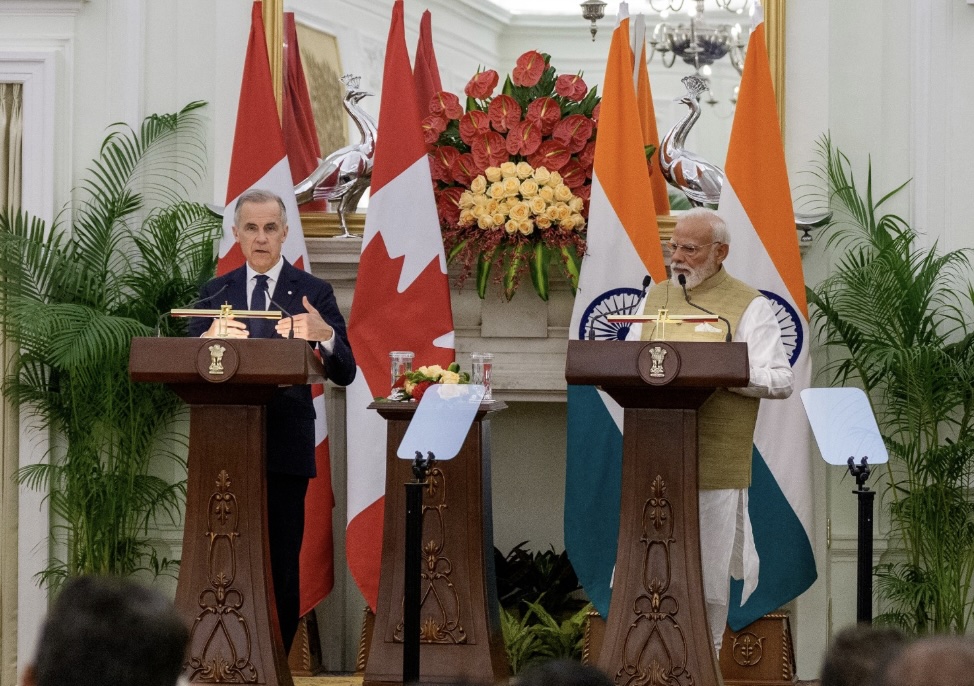
France plays a driving role in this rapprochement between the two continents. For years, Emmanuel Macron has championed a shared Indo-Pacific vision of France’s and Europe’s global influence. One recalls the Indian troops marching along the Champs-Élysées on July 14, 2023. The French President will indeed be in India in February to further deepen, together with Prime Minister Narendra Modi, the friendship and strategic ties between our two countries.
The EU–India Summit taking place these days reflects a Europe seeking to reinvent itself: more competitive, more sovereign, more resilient.
At the Davos Forum, Ursula von der Leyen mentioned a possible historic free trade agreement that could create a market of nearly two billion people. After more than twenty years of negotiations, this project may finally come to fruition. Her words were clear: “Europe and India have chosen strategic partnership, dialogue, and openness.”
This would not merely be a trade agreement. It would be a major geopolitical act in the face of Sino-American tensions, economic fractures, and protectionist temptations.
Today’s India is no longer an “emerging country” seeking recognition. It is a structuring power—demographic, technological, diplomatic. A democracy of the Global South that speaks to the world.
Vande Mataram, Democracy and Identity
This year’s Republic Day carried particular symbolic weight: it also commemorated the 150th anniversary of Vande Mataram, the national song and emotional matrix of the independence movement.
Indian democracy was not built in a vacuum. It was nourished by resistance, but also by poetry, spirituality, and culture. Vande Mataram is its purest expression: a patriotism rooted in dignity, not domination.
This year’s themes—Swatantrata ka Mantra and Samriddhi ka Mantra—sum up this trajectory: freedom achieved, prosperity pursued, autonomy embraced. India seeks to be sovereign without being closed, powerful without being arrogant, rooted without being rigid.
From Rajendra Prasad’s oath in 1950 to the economic ambitions of 2026, January 26 is not merely an anniversary, but a promise of strength and respect.
Michel Taube