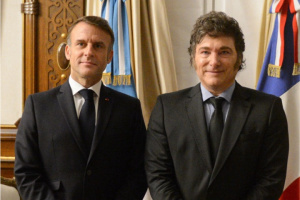




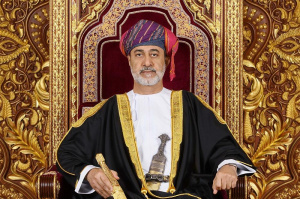
This Monday, June 29, France welcomes a rare guest. For the first time in nearly four decades, a Sultan of Oman is making a state visit to Paris. Beyond protocol, the visit of His Majesty Sultan Haitham bin Tariq marks a major diplomatic moment, at a time when the Middle East is still searching for its balance after months of tension and war.
As the Strait of Hormuz remains at the heart of every strategic concern, Emmanuel Macron is quite right to receive his counterpart in what amounts to far more than a simple bilateral encounter. On the contrary, it is an occasion to rediscover a discreet yet essential partner, one whose influence far exceeds its demographic or military weight.
In a region where the balance of power so often dominates international relations, Oman has chosen another path: that of dialogue, neutrality and mediation.
This singularity is nothing new.
For more than half a century, the Sultanate has built itself around a simple diplomatic doctrine: to speak to everyone without aligning itself entirely with anyone. Washington, London, Paris, Tehran, the Gulf capitals… and Israel as well. Long before the 2020 Abraham Accords, the highly charismatic Sultan Qaboos, Haitham’s predecessor, had chosen to maintain a dialogue with the Hebrew State. In 2018, he officially received Israeli Prime Minister Benjamin Netanyahu in Muscat, convinced that no lasting peace could be achieved without keeping channels of discussion open. Qaboos in fact died in January 2020, several months before the signing of the Abraham Accords. This diplomacy of openness was therefore intrinsic to Oman, and not the product of that normalization process. The various parties involved in the region’s crises thus know that in Muscat, a door always remains open when others close.
This reputation was not built by chance.
Under the reign of the late Sultan Qaboos bin Said, who passed away in 2020 after fifty years in power, Oman became one of the most respected mediators on the planet. His country contributed, often in the greatest discretion, to drawing irreconcilable adversaries closer, facilitating nuclear negotiations, securing the release of hostages and maintaining channels of communication when all diplomacy seemed impossible. Upon his death, he received a tribute of rare unanimity. From the United States to Iran, from the Gulf monarchies to Europe, almost every leader saluted the passing of a statesman regarded as an architect of regional stability. Such a convergence of tributes remains exceptional for a Middle Eastern leader.
At the same time, Qaboos was carrying out an exceptional domestic transformation.
When he took power in 1970, Oman was a poor, isolated and underdeveloped state. Fifty years later, he left behind a modern country, equipped with quality infrastructure, a high-performing education system, a developed health network, solid institutions and a stability that had become almost exceptional in a region nonetheless shaken by conflict.
Few leaders will have transformed their nation so profoundly in a single generation.
His successor, Sultan Haitham bin Tariq, did not choose rupture. He chose continuity. Less media-friendly than his predecessor, more technocrat than charismatic figure, he nevertheless pursues the same ambition: to preserve the Sultanate’s political stability while preparing its economy for the post-oil era. Through Oman Vision 2040, he is betting on economic diversification, new technologies, renewable energy, tourism, logistics and the country’s international appeal.
But it is above all on the diplomatic front that his role appears essential today. The war that pitted Iran, Israel and the United States against one another placed Oman back at the center of the regional game. While the weapons spoke, Muscat went on speaking to each of the protagonists. Where many chose their camp, Oman kept the channels of discussion open. This ability to retain the trust of actors otherwise opposed to one another is today one of its principal assets.
Nearly a fifth of the world’s hydrocarbon trade still transited recently through this strategic maritime route. Any tension in the area immediately reverberates on energy prices, on world trade and on international security. Because it shares sovereignty over this passage with Iran while maintaining close relations with the Western powers, Oman is probably the only actor capable of durably fostering de-escalation.
In this context, the meeting between Emmanuel Macron and Sultan Haitham goes well beyond the framework of a classic state visit.
It opens a window of opportunity to deepen a long-underexploited relationship.
France possesses considerable industrial, technological, scientific, military and energy assets. Oman, for its part, offers rare political stability, an economy in full diversification, a strategic geographic position at the entrance to the Gulf, as well as a unanimously respected diplomacy.
The two countries have every interest in intensifying their cooperation.
Whether in the defense industries, artificial intelligence, infrastructure, low-carbon energy, green hydrogen, research, culture or higher education, the complementarities are numerous.
At a time when global geopolitics is becoming increasingly fragmented, France would do well to multiply its partnerships with states capable of speaking to everyone.
Oman is precisely one of these.
This visit recalls, finally, a truth too often forgotten: the most influential nations are not always the most militarily powerful. Some exercise their influence differently, through the trust they inspire, the stability they embody and the credibility of their word.
For more than fifty years, the Sultanate of Oman has established itself as one of these rare states.
France therefore has everything to gain from durably strengthening this exceptional partnership.
To conclude, one key point deserves emphasis: another particularity sets Oman apart from the rest of the Muslim world. Among the roughly fifty Muslim-majority states, the Sultanate is the only one whose majority religion is Ibadism, a current of Islam distinct from both Sunnism and Shiism. Born in the 7th century, Ibadism traditionally advocates moderation, consultation, religious tolerance and the rejection of extremes. This religious specificity is one of the keys to Omani political culture, founded for decades on dialogue, stability and the search for compromise.
Oman, that other kingdom of moderate Islam, much as we hailed Morocco in 2016, could, we are convinced, play a decisive role in the relaunch of the Abraham Accords and in a long-hoped-for reconciliation between East and West.
Radouan Kourak et Michel Taube