




As Europe continues its endless debates over regulation, artificial intelligence and digital sovereignty, India has chosen a different path: treating digital technology not merely as a market, but as a public infrastructure serving more than one billion citizens.
That model has a name: Digital Public Infrastructure (DPI). It is built on a simple yet transformative idea: governments can develop open, interoperable digital systems upon which banks, fintech companies and private innovators can build. Public architecture, private dynamism.
Of course, this model is not without its challenges—particularly regarding data protection and governance. Yet its impact is undeniable. It has fundamentally reshaped India’s everyday economic life.
Its most powerful symbol is the Unified Payments Interface (UPI), an instant payment system that allows money to be transferred within seconds using nothing more than a mobile phone. From major metropolitan centres to the most remote rural communities, UPI has brought millions of small merchants into the digital economy.
More importantly, this model is no longer confined to India.
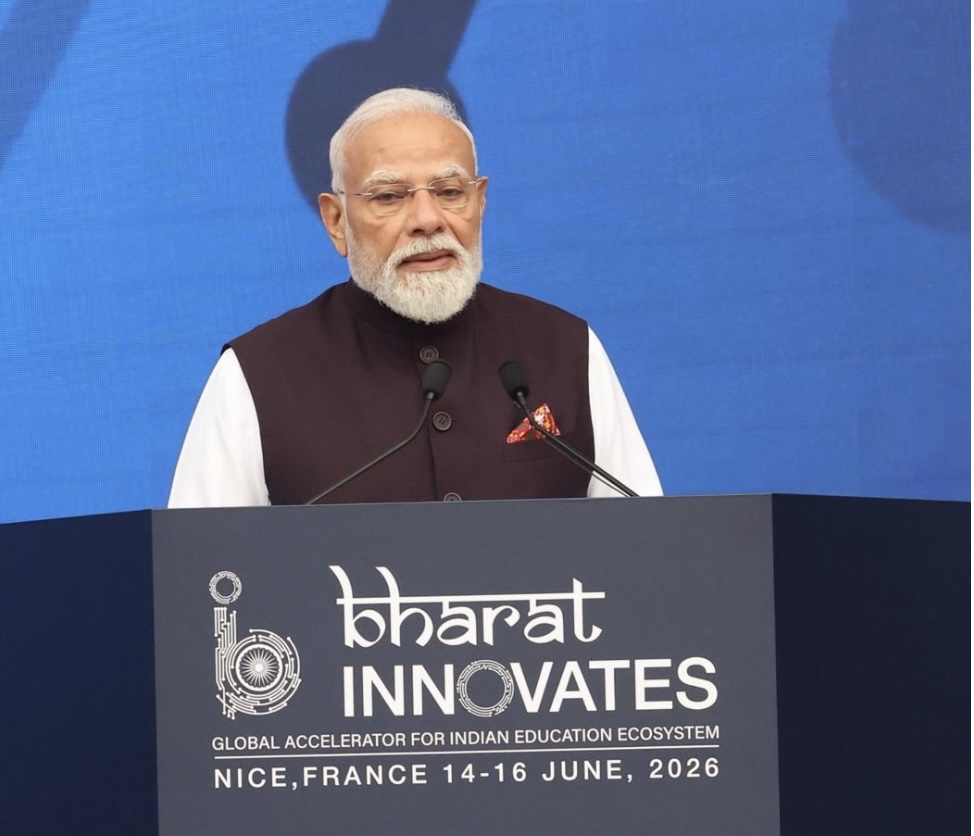
In France, a discreet yet highly symbolic transformation is already underway. UPI is now accepted for ticket purchases at the Eiffel Tower, as well as at the flagship Galeries Lafayette Paris Haussmann store. More recently, it was introduced at Galeries Lafayette Nice Masséna during the diplomatic visit of Prime Minister Narendra Modi.
This is far more than a technical development.
It is a geopolitical signal.
For the first time, an Indian payment system has become partially interoperable with France’s commercial infrastructure. Beyond abstract discussions about « digital sovereignty, » we are witnessing something tangible: the growing interconnection of digital economies.
This momentum forms part of a broader strategic rapprochement between Paris and New Delhi.
For decades centred on defence, aerospace and civil nuclear cooperation, the Franco-Indian partnership is now expanding into strategic sectors such as artificial intelligence, cybersecurity, startups, quantum technologies and digital infrastructure. Under the leadership of Emmanuel Macron and Narendra Modi, technological cooperation has become one of the defining pillars of the bilateral relationship.
Why does this matter so much?
Because Europe now faces a structural technological dependence on both the United States and China. In this context, India is emerging not merely as a vast growth market, but as a strategic partner in shaping a more diversified global digital order.
India offers a different vision: that of a large-scale digital democracy combining rapid innovation with a strategy of technological autonomy. It stands apart from both China’s highly centralised model and the American system dominated by private technology giants.
Franco-Indian cooperation in artificial intelligence perfectly illustrates this convergence. Both countries advocate an approach to AI that is simultaneously innovative, responsibly regulated and firmly oriented towards the public interest. Universities, research institutions, startups and industry are working together more closely than ever before.
Yet Europe must avoid a familiar mistake: imitation.
India’s model is deeply rooted in its own demographic realities, administrative challenges and development priorities. Europe, for its part, remains rightly committed to protecting personal data, safeguarding individual freedoms and maintaining a robust regulatory framework.
Nevertheless, one fundamental lesson stands out: digital transformation cannot rely on regulation alone. It also requires ambitious public infrastructure capable of enabling innovation rather than constraining it.
This is precisely where the European debate must evolve.
France, in particular, is uniquely positioned to serve as a strategic bridge between Europe and India. By expanding the presence of systems such as UPI across its territory, it is doing far more than improving the experience of Indian visitors. It is helping to build a new model of economic and technological diplomacy.
In an increasingly fragmented world, democracies must learn not only how to regulate technology, but also how to build it together.
India does not offer a universal blueprint. But it demonstrates one essential truth: digital technology can be conceived as a public good—one that promotes inclusion, drives economic growth and strengthens economic sovereignty.
For Europe, the question is therefore no longer simply how to regulate the digital world.
It is how to build it.
And perhaps Europe’s next great source of digital inspiration will come neither from Silicon Valley nor from Beijing…
But from New Delhi.
Biren Shah
International Project Management Expert
https://www.linkedin.com/in/birenpshah/