



The Commonwealth Games have often been regarded as the sporting legacy of a bygone era. First held in 1930, they are marking a symbolic milestone this year: their centenary. Yet as the flame was extinguished in Glasgow, another question came to the fore: what future lies ahead for a competition long weakened by financial difficulties and the successive withdrawal of several prospective host cities?
The answer now lies in India.
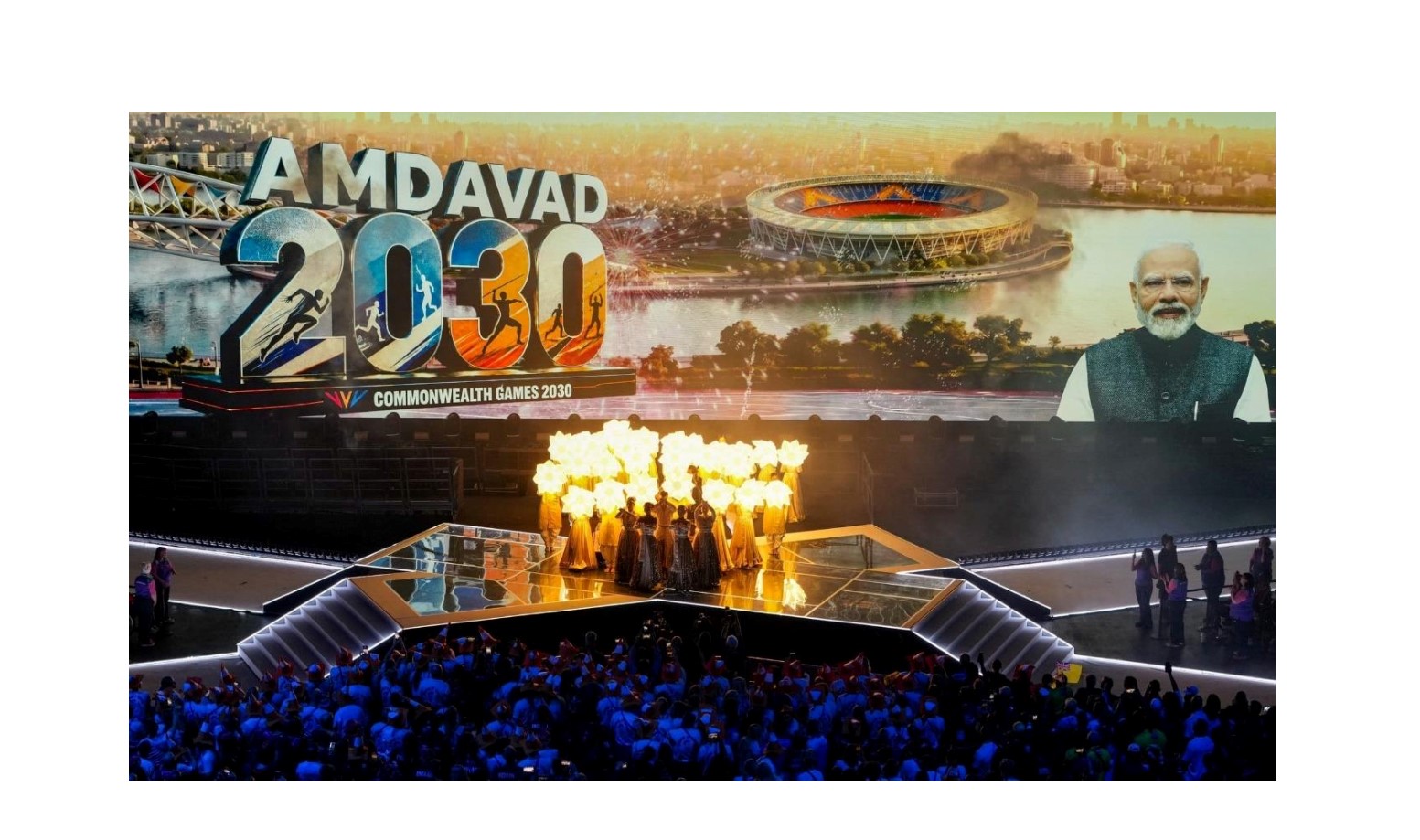
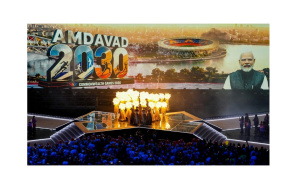
Following the Glasgow 2026 Games, held from 23 July to 2 August, the baton was officially passed to Ahmedabad—or Amdavad, as it is known in Gujarati—which has been selected to host the centenary edition of the Commonwealth Games in 2030.
A competition saved… before being reborn?
The recent history of the Commonwealth Games has been far from smooth.
Following Durban’s withdrawal in 2022 and that of Victoria, Australia, in 2023, many questioned the competition’s long-term viability. Glasgow agreed to stage a radically redesigned edition, with a reduced budget, existing infrastructure and a streamlined programme featuring ten sports, compared with 19 at the Birmingham Games in 2022.
The gamble appears to have paid off.
More than 434,000 spectators attended the competitions over eleven days, demonstrating that a more modest model could preserve the spirit of the Games without compromising their sporting quality.
But Glasgow was also a transitional edition.
All eyes are now on India.
Ahmedabad, a symbol for India
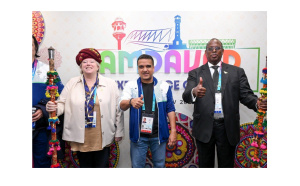
This will be the second time India has hosted the Games, twenty years after New Delhi 2010, and only the third edition to be held in Asia. All 74 Commonwealth national associations are expected to take part.
The event also carries considerable significance at the national level.
For Narendra Modi, the former chief minister of Gujarat, Amdavad represents far more than an economic metropolis. It has become a showcase for the ambitions of modern India, supported by massive investment in infrastructure, transport and sporting facilities.
The choice of Amdavad also extends far beyond the Commonwealth Games alone. The Gujarat metropolis now lies at the heart of India’s bid to host the 2036 Olympic and Paralympic Games. New Delhi has officially put Amdavad forward as its prospective host city to the International Olympic Committee and is continuing its dialogue with the IOC under the new selection process. A final decision is not expected before 2029, but India has clearly expressed its ambition to join the select group of nations that have hosted the Olympic Games.
From this perspective, Amdavad 2030 is far more than a sporting event. Successful Commonwealth Games would provide an invaluable testing ground, demonstrating India’s ability to organise a multisport mega-event, manage world-class infrastructure and convince the IOC that the country is ready for the Olympic challenge of 2036. As so often in sporting history, the Commonwealth Games could therefore become a prelude to the Olympics.
A more ambitious edition
Unlike Glasgow’s scaled-down format, Amdavad 2030 is expected to restore a much broader sporting programme.
Between 15 and 17 sports are planned, including traditional disciplines such as athletics, swimming, boxing, gymnastics, netball and weightlifting. These could be joined by T20 cricket, shooting, squash, hockey and triathlon. Organisers will also have the option of adding up to two traditional sports, fuelling discussions around the possible inclusion of kabaddi or yoga.
The objective is clear: to make the centenary edition a showcase for Indian sport and Asia’s dynamism.
A sporting—and geopolitical—ambition
India is no longer concealing its ambitions.
In recent years, it has successfully hosted the G20 summit, developed its space industry, strengthened its presence in major diplomatic forums, organised international technology events and established itself as one of the G20’s most dynamic economies.
Sport is now an integral part of this influence strategy.
Dr Donald Rukare, President of Commonwealth Sport, said the decision to award the Games to India would open “a new era” for the movement, praising a country that brings “scale, youth, ambition, sporting passion and relevance”.
This vision is shared by P. T. Usha, President of the Commonwealth Games Association of India, who sees Amdavad 2030 as an opportunity to “lay the foundations for the next century” of the Commonwealth sporting movement.
A challenge equal to the expectations
However, nothing can be taken for granted.
The Commonwealth Games must continue to demonstrate their relevance within an increasingly crowded sporting calendar featuring the Olympic Games, world championships and continental competitions.
India will also have to prove that an event of this magnitude can combine sporting excellence, financial discipline, environmental sustainability and a lasting legacy for local communities.
Expectations will be immense.
But that is because the ambitions are equally immense.
Beyond sport
In reality, Ahmedabad 2030 extends far beyond the framework of a multisport competition.
It will be a full-scale test of India’s ability to organise the greatest international events of the 21st century.
The centenary Commonwealth Games will be watched far beyond the stadiums.
By investors.
By diplomats.
By international sporting institutions.
And, naturally, by the International Olympic Committee.
Ultimately, Glasgow demonstrated that the Commonwealth Games could survive by reinventing themselves.
Ahmedabad must now prove that they can regain their ambition.
For India, the stakes extend far beyond medals: the aim is to show that an emerging power can also become a great host nation, capable of combining sport, innovation, diplomacy and international influence.
Opinion Internationale